
motion in one dimension
The position of an object is given as a function of time by x = 4.0t2-3t3, where x is in meters and t is in seconds. What is its average acceleration during the interval from t = 1.0 s to t=2.0 s? (Ans: -19 m/s2)

==============================================
A car starts from rest and undergoes a constant acceleration. It travels 5.0 m in the time interval from t = 0 to t = 1.0 s. Find the displacement of the car during the time interval from t = 1.0 s to t=2.0 s. (Ans: 15 m)

==============================
Figure 1 represents the velocity of a car moving on a straight line as a function of time. Find the acceleration of the car at t= 6.0 s. (Ans: -3.0 m/s2)

==========================================
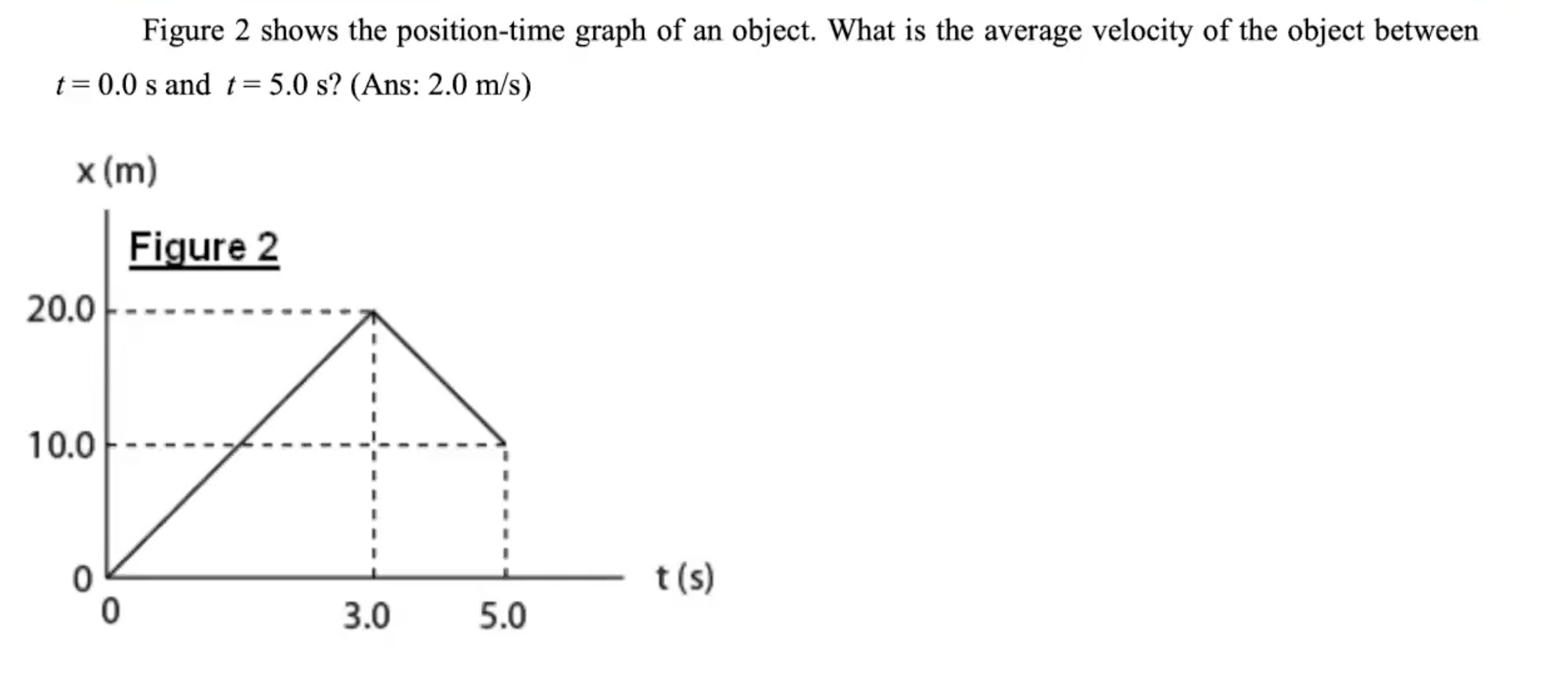
Figure 2 shows the position-time graph of an object. What is the average velocity of the object between t=0.0 s and t = 5.0 s? (Ans: 2.0 m/s)
==========================================
Figure 3 shows a velocity-time graph of a runner. If the runner starts from the origin, find his position at t = 4.0 s. (Ans: 45 m)

==========================================
An object is thrown vertically upward with an initial speed of 25 m/s from the ground. What is the height of the object 1.0 s before it touches ground? (Ans: 20 m)

==========================================
A car starts from rest and accelerates at a rate of 2.0 m/s2 in a straight line until it reaches a speed of 20 m/s. The car then slows down at a constant rate of 1.0 m/s2 until it stops. How much time elapses (total time) from start to stop? (Ans: 30 s)

==========================================
A car travels along a straight line at a constant velocity of 18 m/s for 2.0 s and then accelerates at – 6.0 m/s2 for a period of 3.0 s. What is the average velocity of the car during the whole 5.0-s interval? (Ans: 13 m/s)

==========================================
A stone is thrown vertically downward from the top of a 40-m tall building with an initial speed of 1.0 m/s. How far will the stone travel in 2.0 s? (Ans: 22 m)

==========================================
The coordinate of a particle in meters is given by: x(t)=2.0t – 2.0t2, where the time t is in seconds. At what time will the particle be momentarily at rest? (Ans: 0.50 s)